
















News
20/07/2023
The recent research paper
of CCTP member, E. Kiritsis collaborating with C. Ecker and W. Van der Schee has been highlighted on the cover of Physical Review Letters
You can find the press-release here.
20/09/2021
Distinguished professor and CCTP member Dimitri Christodoulou has been awarded the Henri Poincare prize in Mathematical physics.
You can find the laudatio here.
1/08/2021
Theodore Tomaras passed away after a short illness. Theodore obtained his bachelor from the University of Athens in 1975 and his PhD from Harvard in 1980.
He was senior research fellow at Caltech , assistant professor at Rockefeller University and chercheur associe at Ecole Normale Superieure in Paris, before
becoming faculty at the Physics Department of the University of Crete in 1989.
He has served 31 years as associate professor and full professor at the department, before retiring in 2020, and becoming professor emeritus.
He has been chairman of the Physics department (1995-1999) and deputy chairman (1992-1994), (1999-2201) and (2015-2019).
He has been director of the Institute for Theoretical and Computational physics from (1995-2006) and (2014-2020).
He has also served as chairman of the Technical Board of the University of Crete (2003-2009) as well as president of the Library committee (1990-2000).
He has done important research work on grand-unified monopoles, the instability of De Sitter space, string phenomenology and brane physics as well as on vortices in spin systems.
He has been the recipient of the Stelios Pihoridis award for his excellent teaching performance.
He is survived by his wife Hara and his daugher Avra, to whom we address our condolences.
19/03/2021
The Crete Center for Theoretical Physics has a faculty position opening in 2021. More information can be found here.
28/09/2015
CCTP member Vasilis Niarchos was awarded the first Messinian Prize in Science. This is a new prize instituted by a consortium of benefactors from the Messinian region in the Peloponese. The selection committee was composed of Prof. I. Bakas, J. Iliopoulos and L. Resvanis. Young experimentalist, N. Saoulidou from The University of Athens was also co-recipient of the prize.
21/09/2015
CCTP member, Elias Kiritsis was awarded an Advanced ERC grant for his project "Gravity Holography and the Standard Model (SM-GRAV)". The project will take place in the next five years in two labs, APC at Universite Paris 7 and CCTP in Heraklion.
07/11/2014
A video was made recently by "Aristeia Academy" in order to give prominence to the work of CCTP center. Professors and researchers of CCTP group describe in short the fields of their research as well as their applications. See the video here
05/06/2014
According to the ranking of Leiden University by the criterion of the impact of the scientific publications of the Universities for 2014, University of Crete is ranked 1st out of all greek Universities, 150th in Europe. Moreover it was ranked 5th in the Physical Sciences in Europe after Swiss Federal Institute of Technology in /Zurich (ETH-Z), University of Saint Andrews, University of Cambridge and Ecole Polytech Fed Lausanne. Use the filters to see all the results here
07/5/2014
University of Crete has made it to the list of the best 100 Universities that are under 50 years' old in the world for the third consecutive year, at the 48th place! The publication of the results can be found here.
15/7/2013
CCTP member Ioannis Iatrakis has been awarded
the newly minted Young Researcher's prize of the University of Crete
for the year 2012-2013.
The prize has also been awarded ex-equo to N. Kyriazis from the computer Science department.
The citation can be found here.
The prize, worth 5000 euros, will be shared by the two laureates
who were chosen among 24 runner-ups.
1/6/2013
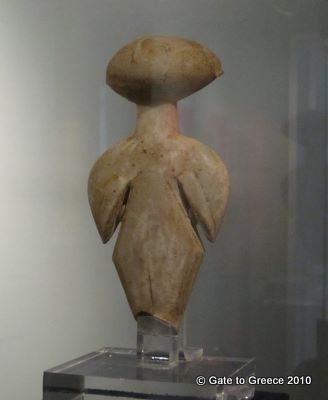
Probably the first the depiction of scientist:
the sculpture belongs to the style known as "Cycladic Art" and has been named the "Stargazer".
It was found at the archaeological site of Kilia, in the Kallipoli peninsula of Eastern Thrace (currently European part of Turkey). It has been dated to the period 4360-3360 BC. It is in display at the Cycladic Art Museum in Athens
20/5/2013
This years' Onassis lectures will feature Nobel Laureate C. Novoselov and Graphene.
The announcement can be found here.
17/5/2013
The bi-annual Physics prizes of the European Physical Society for High Energy Physics have been announced.
The big prize goes to the Atlas and CMS collaborations as well as to Michel DellaNegra, Peter Jenni, and Tejinder Virdee.
20/3/2013
The new Crete Center for Quantum Complexity and Nanotechnology has been
created thanks to a generous grant from the European Union. A website will soon be available at
http://qcn.physics.uoc.gr.
Shortly, there will be announcements for postoctoral openings, informations at qcn@physics.uoc.gr.
3/11/2012
AdS-CFT has emerged from string theory, and has already 15 years of life.
It turned out into a tool that seems to have several applications. A recent panel discussion during the
Nordita workshop
The Holographic Way: String Theory, Gauge Theory and Black Holes"
has addressed the issue of successes and prospects for applied AdS-CFT.
The video can be found here.
5/10/2012
The group of CCTP will meet two local groups, the astrophysics group and the members of the
ACMAC, on Friday October 12, in the afternoon, at the seminar room of the 3rd floor of the Physics Department. The purpose is to interact, get to know each other
and discuss potential subjects of common interest.
This meeting is suported by the European Union (European Social Fund, ESF) and
Greek national funds through the Operational Program "Education and Lifelong Learning"
of the National Strategic Reference Framework (NSRF), under the grants schemes "Funding
of proposals that have received a positive evaluation in the 3rd and 4th Call of ERC Grant Schemes"
4/7/2012
Atlas and CMS announced today compelling evidence for a Higgs-like boson.
The webcast for general public is available at http://cern.ch/webcast
The announcement from R. Heuer, director of CERN:
CERN experiments observe particle consistent with long-sought Higgs boson
Geneva, 4 July 2012. At a seminar held at CERN* today as a curtain raiser to the year’s major particle physics conference, ICHEP2012 in Melbourne, the ATLAS and CMS experiments presented their latest preliminary results in the search for the long sought Higgs particle. Both experiments observe a new particle in the mass region around 125-126 GeV.
“We observe in our data clear signs of a new particle, at the level of 5 sigma, in the mass region around 126 GeV. The outstanding performance of the LHC and ATLAS and the huge efforts of many people have brought us to this exciting stage,” said ATLAS experiment spokesperson Fabiola Gianotti, “but a little more time is needed to prepare these results for publication.”
"The results are preliminary but the 5 sigma signal at around 125 GeV we’re seeing is dramatic. This is indeed a new particle. We know it must be a boson and it’s the heaviest boson ever found,” said CMS experiment spokesperson Joe Incandela. “The implications are very significant and it is precisely for this reason that we must be extremely diligent in all of our studies and cross-checks."
“It’s hard not to get excited by these results,” said CERN Research Director Sergio Bertolucci. “ We stated last year that in 2012 we would either find a new Higgs-like particle or exclude the existence of the Standard Model Higgs. With all the necessary caution, it looks to me that we are at a branching point: the observation of this new particle indicates the path for the future towards a more detailed understanding of what we’re seeing in the data.”
The results presented today are labelled preliminary. They are based on data collected in 2011 and 2012, with the 2012 data still under analysis. Publication of the analyses shown today is expected around the end of July. A more complete picture of today’s observations will emerge later this year after the LHC provides the experiments with more data.
The next step will be to determine the precise nature of the particle and its significance for our understanding of the universe. Are its properties as expected for the long-sought Higgs boson, the final missing ingredient in the Standard Model of particle physics? Or is it something more exotic? The Standard Model describes the fundamental particles from which we, and every visible thing in the universe, are made, and the forces acting between them. All the matter that we can see, however, appears to be no more than about 4% of the total. A more exotic version of the Higgs particle could be a bridge to understanding the 96% of the universe that remains obscure.
“We have reached a milestone in our understanding of nature,” said CERN Director General Rolf Heuer. “The discovery of a particle consistent with the Higgs boson opens the way to more detailed studies, requiring larger statistics, which will pin down the new particle’s properties, and is likely to shed light on other mysteries of our universe.”
Positive identification of the new particle’s characteristics will take considerable time and data. But whatever form the Higgs particle takes, our knowledge of the fundamental structure of matter is about to take a major step forward.
Pictures available here
Footage available here
8/6/2012
Four Gran Sasso neutrino experiments including OPERA have verified that neutrinos move at canonical speed from CERN To Gran Sasso . The earlier positive OPERA result was due to errors in a faulty wire system (that increased the speed) as in the granularity of the timer (that reduced the speed).
14/5/2012
The paper Poor man's holography: How far can it go? by CCTP member Hong Bao Zhang and collaborators was awarded the honorable mention of the Gravity Research Foundation
3/5/2012
The CCTP features in the list of excellence projects of the Greek Ministry of Education.
25/3/2012
CCTP project "HEPCOSMO" was selected for funding in the Greek Secretariat of Research and Technology's recent "Aristeia" (Excellence) call for projects. Two hundred research projects were selected in all sciences. You may find the press release from GGET here.
20/3/2012
CCTP project "Holography and Condensed Matter Physics" was awarded a research grant from the Greek Secretariat of Research and Technology. The project will explore the application of recent techniques developped in string theory to study strong coupling problems to strongly correlated systems in condensed matter physics. 7 such grants were awarded in all sciences in Greece.
20/11/2011
CCTP member, E. Kiritsis was elected to the High Energy Particle Physics Board of the European Physical Society.
18/11/2011
The OPERA Collaboration has improved the most important factor for error, by running and collecting 20 extra neutrino events with shorter proton bunches from CERN. According to the paper posted today at the ArXiV, the speed of light discrepancy remains. Relativistic corrections to the path were estimated and found negligible.
2/10/2011
D. Christodoulou, distinguished professor at CCTP, was recently awarded the prestigious Shaw prize for the Mathematical Sciences, shared with Prof. R. S. Hamilton. The prize was given for their highly innovative works on nonlinear partial differential equations in Lorentzian and Riemannian geometry and their applications to general relativity and topology.
29/09/2011
An article by E. Kiritsis on superluminal propagation in string theory, published by the kathimerini newspaper, in view of the recent experimental claims on the speed of neutrinos.
23/09/2011
A remarkable claim has been made by the OPERA experiment, that takes a neutrino beam from CERN and studies its interactions inside the Gran Sasso laboratory in central Italy.
As described
in their paper http://fr.arxiv.org/abs/1109.4897 submitted to
the ArXiV, they have measured the velocity of the neutrinos and found it to be 2.5 X 10^(-5) times larger than that of light in vaccum, using a
clever technique proposed in http://arxiv.org/abs/0805.0253.
The result is more than 6 sigma away from the expected value of the velocity of neutrinos, namely the velocity of light.
The result is so unexpected that it will take some time untill it passes further scrutiny and is confirmed by other experiments.
It should be noted that Supernova 1987a data already excluded this state of affairs if the phenomenon is energy independed. However
as supernova neutrinos had an energy of about 10 MeV while OPERA neutrinos have 10 GeV, it suggests that the effect has quadratic dependence on energy and is therefore due to a non-renormalizable operator.
A potential loophole that has not obviously been considered is the use of general relativistic corrections to the path of neutrinos.
These may correct the result wich takes as the distance the straight line between emission and interaction points.
A simple newtonian simplified solvable model indicates that such corrections give an effective speed that is larger than
than the standard one. In Scwartzschild modeling of the gravitational field f the earth, the (small) parameter that controls the
gravitational corrections is x=GM/(Lc^2) where G is Newton's constant, M the mass of the earth, L is the length of the path (about 750 Km)
and c is the speed of light in vacuum. We expect the result to have a regular expansion in x. Putting the values of the various constants we obtain that x~10^(-8) and is probably too small to affect the result.
There are not many theoretical ideas on how to achieve this state of affairs from first principles assuming that the experimental result is correct.
Of course one could just postulate that the speed of neutrinos is different (larger) than c, but this is excluded by supernova data.
To make it compatible with such data , Lorentz invariance should be broken.
There is however another way that is possible: to have the SM live on a brane-world and the neutrinos to be able to travel in a warped bulk.
This phenomenon was found first as a side effect in a holographic study of the effective potential in N=4 superYM using probe branes by CCTP member E. Kiritsis in
hep-th/9906206. It was observed that on a brane, embeded in the background of other black branes, a velocity of light is induced on the brane, that is variable and depends on its position in the bulk. Moreover the velocity of light is smaller that that of the bulk. S. Alexander shortly afterwards provided some brane models
that stabilize such a velocity of light to arbirary small values. This line of ideas lend to the developement of the idea of
Mirage Cosmology.
Gubser, several years later generalized the proposal to geometries that are entropy-less.
Such geometries appear for example in holographic finite density saddle points.
A bit later and probably independently,
Chung and Freeze suggested that faster propagation outside of branes could be used to solve the horizon problem in cosmology. This subject was subsequently developed by Caldwell and Langlois.
Finally Gibbons and Herdeiro have shown in full generality that the speed of light on D-branes is always smaller or equal to that of the bulk.
This line of reasoning suggests that models where (a) the SM is living on a brane, and (b) neutrinos can move in a approapriately warped bulk can natuarally produce a superluminal speed for neutrinos.
Such models where entertained in the context of orientifold in string theory in
hep-ph/0004214
and in more detail in hep-th/0210263 by I. Antoniadis, E. Kiritsis, I. Rizos and T. Tomaras. In these works the foundations of the bottom-up approach to string theory model building were introduced.
The right-handed neutrinos were living in the bulk and they were mixing with the doublet neutrinos on the brane.
This could potentially provide a first principles model compatible with the OPERA data.
8/09/2011
CCTP researcher Takeshi Morita was honored with the "Young Scientist Award of the Physical Society of Japan" in 2011, for his contribution in http://arxiv.org/abs/arXiv:0910.4526 and related works. T. Morita and senior researcher V. Niarchos have also published recently a very interesting work where they verify the F-theorem in 3 dimensions and present an interesting condition for non-perturbative supersymmetry breaking.
30/05/2011
J. Iliopoulos, S. Glashow and L. Maiani have been awarded the 2011 prize of the European Physical Society for their work on the GIM mechanism. You can see the citation here. An interesting exposition of the history and issues surrounding the GIM mechanism can be found at the Scholarpedia.
15/05/2011
The paper A Gravitational Mechanism for Cosmological Screening by CCTP member N. Tsamis and R. Woodard was awarded an honorable mention by the Gravity Research Foundation.
27/11/2010
The first Pb-Pb heavy ion collisions at 2.76 TeV were succesful at LHC. The
ALICE experiment has already produced two papers
on Elliptic flow and charged multiplicities
There are several animations of the reconstruction of the first events here:
Animation 0
Animation 1
Animation 2
Animation 3
Animation 4
Animation 5
13/12/2009
The work of Center members and their European collaborators was recently highlighted in Physical Review Focus. The occasion was a recent high-precision lattice calculation by Marco Panero of the thermodynamic functions of SU(N) Yang Mills theory for different values of N. This study has shown that there is little variation of the thermodynamic functions with N, suggesting that string theory descriptions of the deconfined phase of Yang Mills theory, valid at large N, are close to the physics of the SU(3) theory relevant for the strong interactions. Moreover, the thermodynamic functions were compared successfully with predictions from a semi-phenomenological holographic model, developed earlier. Such a model has two extra adjustable parameters compared to Yang Mills, and can quantitatively reproduce 0^{++}, 0^{+-}, 2^{++} glueball spectra at zero temperature, the deconfining phase transition as well as the thermodynamic functions, and the spatial string tension at finite temperature.
12/12/2009
Το Κέντρο Θεωρητικής Φυσικής Κρήτης (Crete Center for Theoretical Physics) οργανώνει στις 27/02/2010 την ημερίδα International Particle Physics Masterclasses, σε συνεργασία με το European Particle Physics Outreach Group και το Ελληνικό του τμήμα Ελληνική Ομάδα Εκλαίκευσης". Για πληροφορίες ακολουθείστε τον σύνδεσμο.
An outreach day, is organized at the Physics Department on 27 February 2010. Its purpose is to bring the excitement of recent advances of High Energy Physics and of upcoming experiments at CERN to high school students from Crete. More information can be found here (in Greek)
10/11/2009
The Advisory Committee of the Center will visit during the week 17-20 November 2009.
They will consult with Center members on Wednesday and Thursday.
C. Callan will give the department colloquium on Thursday.
G. Veneziano will give the High Energy Physics Seminar on Friday.
16/09/2009
One of the
Center research papers has made it at position 43 into
SPIRES' 2008-2009 top-cited list (containing 57 papers with more than 50 citations).
The paper discusses the cosmology of Horava-Lifshitz gravity, a radically different theory of gravity proposed recently.
It has currently 96 citations, reflecting widespread scientific interest in this new theory.
15/09/2009
The Center starts its postdoctoral campaign for the 2010 academic year.
We will have at least one and possibly more postdoctoral positions in the areas of particle physics and cosmology.
Deadline for applications is 1 December 2009.
More information can be found at job opportunities
16/05/2009
The Center is open to application of candidates for the European Marie Curie Fellowships.
Deadline is 30 June 2009. Deadline for the EU is 18 August 2009.
More information can be found at job opportunities
16/05/2009
The Center is looking for a part-time secretary. Here is the
announcement and details. Deadline is 31 May 2009.
18/04/2009
Το Κέντρο, σε συνεργασία με το Τμήμα Φυσικής, διοργανώνει την 13η Ιουνίου, εσπερίδα διαλέξεων απευθυνόμενη στο ευρύ κοινό, για να γιορτάσει τη συμπλήρωση 30 χρόνων από την δημιουργία του τμήματος Φυσικής.
Τρεις διάσημοι Έλληνες Φυσικοί έχουν προσκληθεί για να παρουσιάσουν τις μοντέρνες θεωρητικές ιδέες στη Φυσική Υψηλών Ενεργειών και την Kοσμολογία καθώς και τα μεγάλα σύγχρονα πειράματα που ερευνούν τα μυστικά της φύσης στα όρια της σημερινής γνώσης!
Περισσότερες πληροφορίες μπορούν να βρεθούν στην αντίστοιχη ιστοσελίδα.
15/03/2009
An outreach day, is organized at the Physics Department on 21 March. It purpose is to bring the excitement of recent advances of High Energy Physics and of upcoming experiments at CERN to high school students from Crete. More information can be found here (in Greek)
22/02/2009
An informal workshop will be organized 8-12 May. More information can be found at Conferences
15/01/2009
The 5th Crete Regional Meeting on String Theory will take place in Kolymbari, 28 June-6 July 2009. More information can be found at Conferences
15/01/2009
Our postdoctoral campaign has finished for the current academic year. Details can be found at Jobs
15/10/2008
Several research positions are open. Details can be found at Jobs